
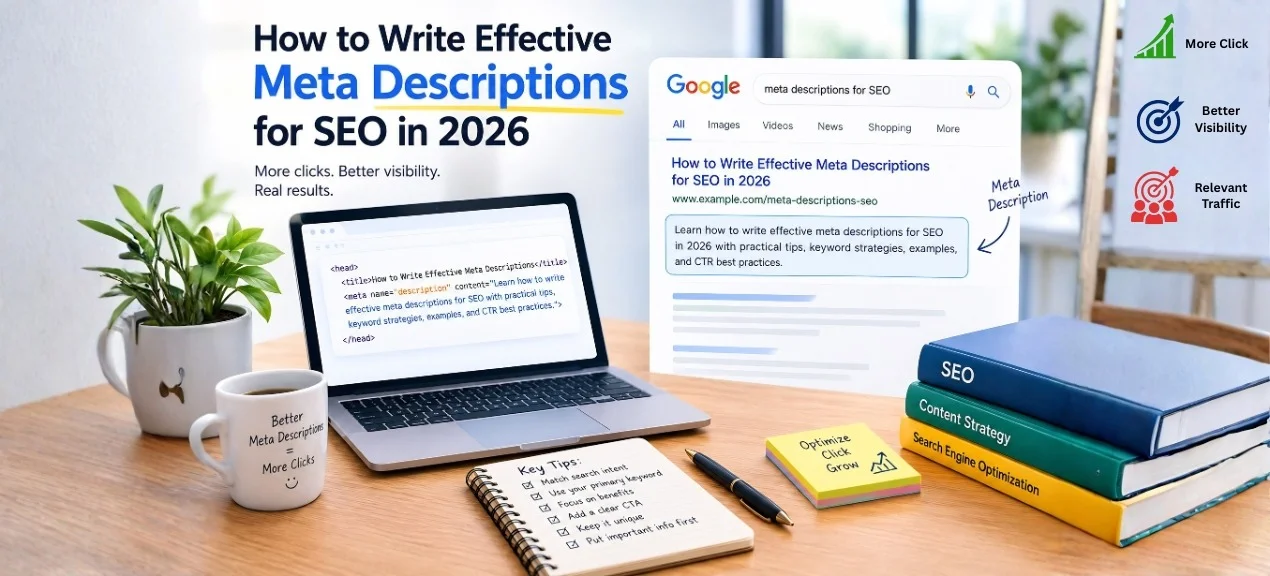
Meta description can influence the visibility of your page in search engine results. It provides searchers with a fast motivation to go to your website. A meta description should offer a clear explanation of the page in easily understandable language. This should be in line with what the searcher needs.A lot has changed in the SEO field from 2006 to 2026. The search engines have become more capable of showing richer search results and providing direct answers. Moreover, AI search technology has influenced the discovery process of websites by people. Nevertheless, the meta description continues to hold significance for effective search communication. The aim is not to use keywords for the sake of them.
What Is a Meta Description?
Meta description is a brief description of the page. This piece of information appears inside the HTML document of this page. Search engines might display it under the title of this page in the SERP. The user will be able to read this piece of information before making a decision to go on your website. You might consider this description to be an introduction to your page. It explains to users what is waiting for them after the click. The product page might describe the product and its benefits. Service page may introduce service and its benefits. The blog post may provide the answer to the question, as stated in the title of the blog post. The category page can serve as an introduction to the products or services that are offered in this category.
Why Are Meta Descriptions Important for SEO?
A meta description is important since it will give the user more context about the search results. Before selecting any option, consumers usually weigh at least two options. The purpose of the page should be apparent from the title of the page. More context can be given in the meta description which could make your result more appealing. In the case of a vague description, users will have no reason to click on your result. However, the specific description can inform users about the benefits they can receive by clicking on the result. For instance, a clothing category can tell about the products it offers and styles. A service page can mention the issue it solves.
A guide can tell what the reader will learn by visiting the page. This will help to establish better connections between the search and your page. Also, meta descriptions are important in shaping your message on the search result. Google can use the description or pick some other text on the page. However, creating a relevant description will provide Google with more context. It will also give you an opportunity to influence the message you want users to read. It should help users to click but not make false promises.
Are Meta Descriptions a Google Ranking Factor in 2026?
Meta descriptions will stop being a real Google ranking element in 2026. The search engine will not consider the text as a direct means for ranking your page. This does not mean that you should disregard meta descriptions. They have their value but it is mostly in terms of search experience. A helpful description can make your result more interesting and relevant for searchers. In addition, Google can use your description to display text from other parts of your page.
This occurs when the other part seems to be more relevant to the user’s query. In such a way, you cannot control what will actually be used in your search result snippet. However, a good description provides Google with valuable data about your page and gives you a good basis for composing your search result message. Do not treat the meta description as a trick for rankings; see it as a means to make users click through. Relevance has to be indicated by your title. Your content should cover the question raised by searchers. Your description should promote visits and your page experience has to deliver it.
How Long Should a Meta Description Be?
There is no specific character limit to generate the best meta description. The length that will be shown by the search engines depends on various parameters such as the kind of device used and the nature of the search query. . Google sometimes also modifies the meta description snippet according to the purpose of the search made by the user. This is the reason why it is important not to be concerned about the exact character limit while writing a meta description. The priority should be more on the quality of the message rather than anything else. The meta description should be short and the most important details should be written in the opening part to ensure that even if the search engine cuts down on some part, then the important message is retained. A lot of experts generally stick around the character limit of 150-160 for meta descriptions. Still, it is not mandatory and one can make their descriptions shorter or longer according to requirement without compromising on the quality of the content.
10 Meta Description Best Practices for 2026
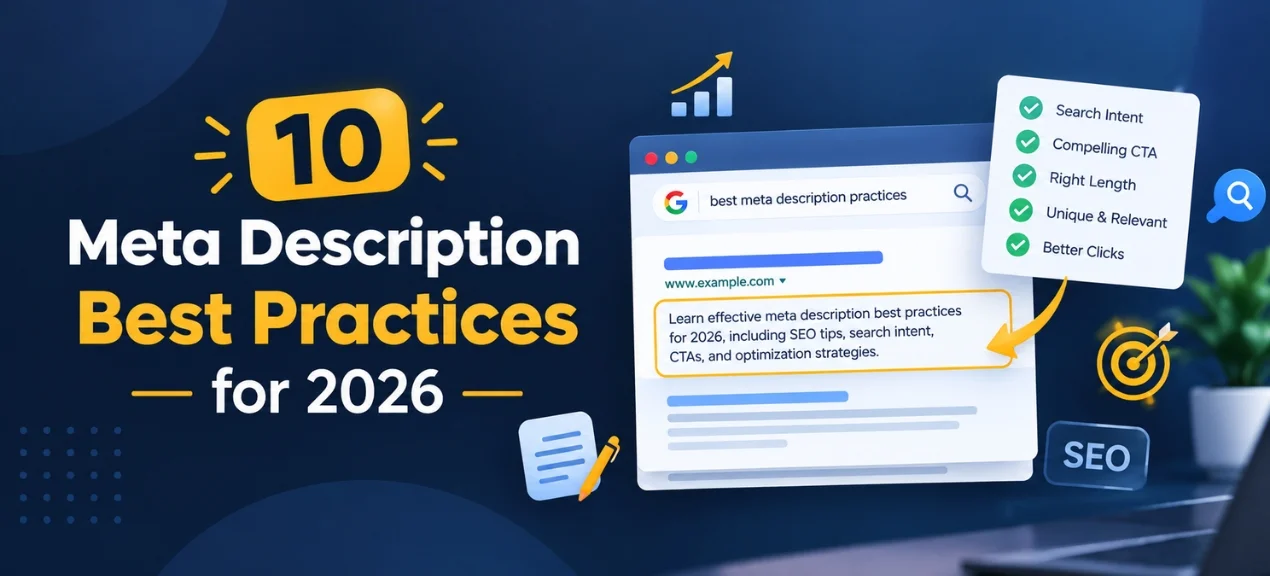
1. Match Search Intent
Your search intent should determine your meta description. People have different reasons when they search online. There are some people who search because they want an answer to their queries. There are some people who search because they want to compare different products. Others want a service or simply want to buy something. You need to include this in your description. The person who is searching for men’s wool shawls will be looking for different options. In contrast, the person who wants to know how to select wool shawls will need a different kind of meta description. You need to see the search query and then write your meta description according to the needs of the searchers. What do you think the searcher wants right now? Tell him/her why your page is useful for him/her.
2. Write a Unique Description for Every Important Page
Important pages should be assigned unique meta descriptions. Repetition of the description for a number of pages can make them seem unremarkable. Customers will have difficulty in identifying the differences between pages. Search engines can find it difficult to understand the unique nature of each individual page. In order to overcome this problem, you should create a unique description. Every page which is significant should be assigned a description which suits the content. The description for a category which contains wool shawls should be different from the description for acrylic shawls. Product pages should also get a unique description as per the nature of the product. It does not mean that you will need to put in equal efforts for every insignificant page on your website. You can begin with your home page, major categories, important products, service pages, and valuable articles.
3. Include the Primary Keyword Naturally
The primary keyword could help you link your description to the search query of the user. Your keyword might be bolded if it is related to the search query. The keyword should always be used in a natural way. It should never be used several times in one description. Do not create weird sentences just to use the keywords. If your chosen keyword is ‘Kashmiri shawl price’, then you can use this keyword in a sentence in which it naturally fits. The description should make perfect sense without the keyword too. Search engines have become quite smart at understanding language and context. They don’t require you to stuff keywords anymore to demonstrate relevance. Just start with the requirement of the user and the topic of the page and add the primary keyword to support the message.
4. Focus on Benefits
Features help users understand what you are offering. Benefits help users understand the importance of the offer. This may help in making the description more effective. Let us take an example of selling wool shawls. In the latter case the message is closer to the customer’s needs. The same thing holds true for services as well. Bookkeeping services may be sold by focusing on accurate record keeping. Cleaning services may be sold by focusing on a clean and comfortable environment. Roofing services may be sold by focusing on the protective aspect of the roof. Use benefits which suit the web page and search intent. Avoid exaggerations which your website will not be able to support.
5. Keep the Description Accurate
In the area of writing accuracy is of utmost importance. Your description must match what you want to display when someone clicks on it. Mentioning an expired discount in the search result description does not make sense. Promising products in your description that do not exist on the page is a bad practice too. Saying that your product does something that you cannot guarantee is misleading and wrong. You can trick someone into clicking on your page, but you may ruin the trust afterwards. Users expect your page to give what was promised in the search result. In this case, your description and page will align in meaning. It means that users know what to expect after clicking the link.
6. Add a Clear Call to Action
A good call to action lets you know what action the reader is supposed to take. Users will be asked to do different things on the various types of pages. For a product page, the CTA will be inviting the reader to visit the shops and for a service page, it could involve asking the user to get a quote from your service provider. For an informational piece of writing, you could ask the reader to learn more about the information provided. The CTA should fit well in the context of the description without making each page seem like a sales page. For commercial pages, since the customer might already be thinking of buying, you can go for strong action words. For informational pages, however, you need to take a softer route.
7. Write for Humans, Not Just Search Engines
Search engines are important, but your target customer is reading your search results. For that reason, your description needs to sound like human speech. Avoid strings of keywords and robot-like phrasing. Avoid saying the same thing about your business over again in different words. Instead, consider who has searched for something online. What is their question or problem? What is the answer that they need? Use that information to inform your description. A clothing retailer can highlight style, comfort or selection. A local business can highlight convenience and credibility. And an educational piece can highlight the answer it offers. By writing from a human perspective, you improve clarity and create credibility. The best descriptions don’t read like SEO content.
8. Put Important Information First
The most critical part of your meta description is the opening one. It is possible that search engines will trim down the content you provide. First write down the core content (topic, benefit or value). Then continue with additional information. For example, for product pages, this core information might be either the name of the product or its main benefit. In the same way, for service pages, the core might be the service itself and its main advantage. For guides – it is the answer or learning value. You may put a CTA at the end if it suits your case.
9. Optimize Descriptions for Different Page Types
Each page should have a distinct purpose. Meta descriptions need to be aligned with that purpose. The description for the product pages must contain information about the product and its most appealing aspects. A description of the category page needs to highlight the collection or range of products offered. The service pages description must provide an insight into the service as well as the issue it solves. A blog page description needs to inform the visitors what type of information will be presented there. A description of the comparison pages must provide information on what exactly the user can compare. The landing page description must have an emphasis on the offer and the next steps the visitor must take. For instance, the description for the category page can include “men’s wool shawls, classical style and winter warmth”. The description for the comparison page can have “wool, acrylic and polyester” and emphasize the difference between them.
10. Review and Update Important Descriptions
Your meta descriptions should not stay static forever. Your site will evolve; your products will evolve; your services will evolve; your prices or offers will evolve. Even searchers’ behaviors can evolve. And your descriptions have to stay relevant to all these changes. Periodically look at the important pages of your site. Prioritize those that get good traffic through search. Make sure that the description still corresponds to the content of that page. Make sure there are no outdated promises and poor CTA. Also, make sure that the description is relevant to the current search intent of people visiting the page. Search performance statistics will help you in doing so. You can use Google Search Console to analyze the performance of your pages in search. Analytics data will help you, too. But don’t do any changes without a good reason.
Meta Descriptions vs Page Titles
Title and meta description have their own functions. The title needs to quickly identify the page. Meta description will provide more context. Title and meta description need to complement each other rather than use the same sentence twice. For instance, one can use “Men’s Wool Shawls | Classic Pakistani Styles” for the title. Meta description will further provide details on what the collection comprises, what material is used, how comfortable the shawls are, and why they have that classic Pakistani style. In essence, it provides additional information prior to clicking on the page. Consider the title to be a good headline. Consider the meta description to be a supporting statement.
Meta Descriptions for Ecommerce Pages
The ecommerce pages should have a more commercial approach. The users might already be looking for a certain product. You need to provide some features in order to convince them to look at your page. List out important qualities of the product according to the user needs. It could be about the material, style, type of the collection, comfort, or price. However, do not list out every little detail that comes to your mind. Pick the relevant aspects which would help the user in making up his/her mind. The Men’s Shawl category can list down classic styles, quality of the wool, and winter comfort. Product Page can list out qualities of that product only.
Meta Descriptions for Service Pages
Your page must feature a solution oriented message. When someone is searching for a certain service chances are high that he or she is seeking to solve an issue or address a problem. Your description should tie the service to this problem. For instance, a roof repair firm can emphasize home safety and reliable roof repair services. A cleaning firm can concentrate on a fresh and cozy home or office environment. An accounting firm can stress proper record keeping and organization of accounts. You begin with the service when it is applicable. Then follow it up with the key benefit. Conclude with the call to action where necessary.
Meta Descriptions for Comparison Pages
Description is a must on comparison pages. Searchers get to these pages because they are at a crossroads and have to choose. They want to be aware of the difference before buying. Describe your comparison on your landing page clearly and specifically. Mention the main alternatives and parameters to consider. In case you compare different types of shawls, mention wool, acrylic and polyester. You can compare them by mentioning their difference in warmth, comfort, longevity and price. That will give users an explicit reason to visit this page. Never use generalizations like “Find the best option for you.” Users should be clear about what exactly they will compare.
Common Meta Description Mistakes
The meta descriptions on many websites are an afterthought. As a result, there may be poorly written or bland search result messages. One such error is keyword stuffing. Another issue is the presence of duplicate descriptions. Websites fail to give some of their pages unique descriptions. Other descriptions include promises that cannot be fulfilled by the web page. There are descriptions that highlight features without giving any benefit. Other descriptions do not have any reason for a visitor to click. Extremely long descriptions may hide the message within them. Similarly, extremely short descriptions may not offer sufficient context. The key lies in putting the needs of the user first. Understand what the user is looking for in his search. Then give him a reason to pick your website over others.
How Meta Descriptions Fit Modern SEO in 2026
SEO has now evolved past the realm of normal search results. AI-based search can actually give a direct answer and summary. The search engines themselves also have evolved in terms of their search capabilities. There are times when people get what they need without ever going to a website. Therefore, there is the need for a good page and description for people to find useful things. Your meta description should be in support of the page and not in place of it. Your title should explain what you are talking about. Your description should justify your search decision. Your page content should give the actual answer or solution. Finally, your website should give people a great experience.
Final Thoughts
Writing good meta descriptions in 2026 does not need to involve complex SEO vocabulary. It just requires a clear mind and an understanding of search intent. Your description must tell users what is there on your page. It must also make them understand why they would want to look at that page. Use your main keyword in a natural way. Think about actual benefits of visiting that page. Your description should be accurate and related. Put essential information early in your description. Use a CTA where needed. Write unique descriptions for pages that matter to you the most. Revisit them when your content/products/services/promotions change. Most importantly, always think about the reader first. A meta description is much more than an SEO box. It is one part of the overall search result message. It influences the user’s decision of which result to choose. Clear wording could win the user’s interest. Relevant information could win her trust. An interesting message could win the click. This is how your meta description works in 2026.