
Search has changed a lot in 2026. People want quick answers, clear facts and useful content. They do not want pages made only for search engines. They want content that solves a real problem. That shift makes audience first SEO more important than ever. Audience first SEO puts people before keywords. It focuses on search intent or useful answers or clarity and experience. Although keywords are still important they function better when they address actual user demands. One straightforward question is the foundation of a successful SEO strategy. What does the reader really need? Your title might be used for two main purposes. Once you know that answer or content becomes easier to plan. It also becomes easier to rank, attract visitors and earn trust.
What Is Audience-First SEO?
The audience first SEO involves creation of content first for people and later optimization of the same for search engines. The needs of the readers will determine the subject matter, structure, style, examples, and the level of depth in the content. This approach begins with consideration of the search intent rather than the amount of keywords. In this case, you will ask yourself the reason for searching and also the kind of answer expected. If the search is for best running shoes, it implies that the reader is looking for options, while a search for a running shoe size guide will involve an expectation of answers. While the two keywords might be related, the needs of the reader are not similar, hence this method considers the need and creates pages that fit the search intent.
Why Is Audience-First SEO Important?
There are numerous signals by which search engines analyze web pages nowadays. These include relevance, usefulness, context, and page quality. Thus, thin content that is aimed purely at achieving high rankings does not do the job. It is possible for a web page to be targeted at an important keyword but at the same time not to deliver its message. The reason may be a lack of detail or answering the wrong question or making a reader put extra effort into understanding what the content is about. Audience first SEO tackles all these issues from the very start. First you learn about your audience and its needs and then write the content with regard to those. It will positively affect various aspects of your SEO tactics. Visitors will read useful content longer or browse other web pages and even take action because of your brand credibility.
Audience First SEO vs. Keyword First SEO
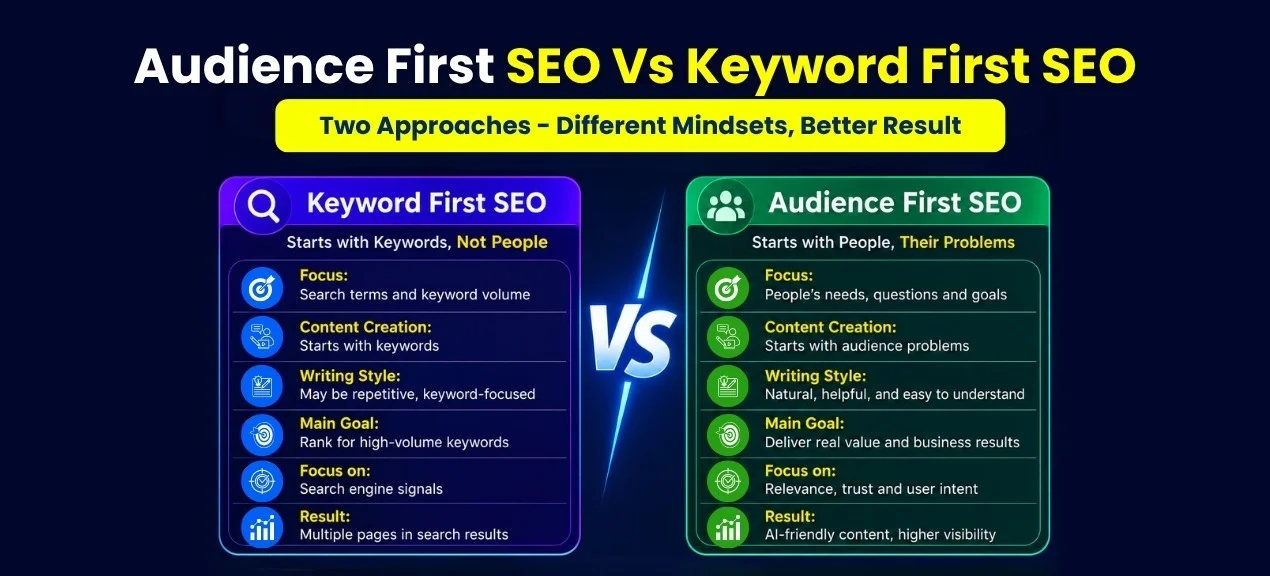
SEO based on keywords involves search terms first of all. The process usually starts with finding these search terms, and then the writer creates the content using these terms. The audience-based SEO is different in that respect. It always starts with the audience and its search problem. The content based on keywords might be repetitive in the use of one phrase, whereas the audience-based content uses related language in a natural way. Keyword-based content might focus on the high search volume, while audience-based content focuses on relevance and business value. Neither method excludes the importance of keywords. Key phrases remain relevant to provide the sense of the topic of your page to search engines. The only change is in the way of their usage. You can treat keywords as signals or not instructions. Your keyword might set the direction of your topic while the audience should set the direction of your answer.
How to Understand Your Target Audience
Audience based SEO needs a comprehensive understanding of your audience. It is not enough for you to know their age, location and occupation. You have to know what their problems are or what their objectives are or what they fear and why they have to act.The search queries give away all of this. The customer feedback will give away their issues. The sales pitches will expose their objections. The support requests will divulge their questions. The social media networks will expose their language for stating their problems. You can learn from your own web analytics as well. Analyze the traffic on your website and look for those pages where qualified visitors come to you. Learn what kinds of questions drive your audience to your website.
Create Content That Answers Real Questions
People search for something. They want information, a product, a solution, or a comparison of multiple things. The content should understand their intent. It should start from the initial query that is asked and then provide the necessary information needed by the user. There shouldn’t be lengthy introductions delaying the provision of the actual answer. Users should get the information without being forced to read multiple paragraphs. Good content respects the users’ time. Moreover, it provides the answers to the secondary queries that logically arise out of the initial one. For instance, if it is a comparison of products, it will contain all information on prices, qualities, uses, and values of those products. If it is a page for a service or it will describe how, when and why that service is provided.
Make Your Content Easy to Read
A good piece of information becomes useless when the reader fails to understand it. It is important to write using simple language for faster understanding. Use simple sentences and simple words. Each paragraph should cover one point. Do not use hard words where easy ones can be used. Use simple headings to make your points clear. Give each point enough space but do not include unnecessary details. The reader should not struggle to understand your ideas. This is also true when it comes to mobile phones. People usually scan web pages to determine whether they will need to read them. Readable content increases the level of trust. People trust brands that explain difficult concepts clearly.
Cover the Topic Completely
Audience first SEO does not mean writing short content. It means writing useful content with a clear purpose. Topic depth should match the reader’s needs. A simple question may need a short answer while a complex buying decision may need much more detail. Complete content covers the important parts of a topic. It answers the main question, addresses common concerns, explains important differences, and gives context where readers need it. It also avoids unrelated information. For example, a buyer guide should help buyers choose. It should not become a history lesson about the product. Topic completeness means useful coverage, not unnecessary length. Search engines can understand related concepts through context while readers can recognize expertise through helpful details.
Optimize Titles for Readers and Search Engines
Your title has two main roles. It needs to describe the page and entice the right kind of person to click on it. A good title is written using simple language that sets proper expectations. You can even use the primary keyword if it fits. Do not use a title that promises one thing but delivers another on the page. While you may get clicks with such a title or there is a risk of damaging trust once people realize they have been misled by the title. This is why an effective title sets the proper expectation. For instance, Audience First SEO the better way to rank in 2026″.
Improve the User Experience
SEO is not the end game once you get someone to click your listing; it is also about ensuring an optimal experience once they get there. They should not have to put in any unnecessary effort to access information. Your site needs to be quick to load, easy to navigate and have content presented clearly. There should be links for further research, images should complement the content and mobile users should be provided with a good experience too. You should never create an experience that makes reading challenging or hides content behind other distracting elements. A good user experience complements the purpose of your content and helps users focus on their objectives. This may even improve their impression of your brand.
How to Measure Audience-First SEO Success
Rankings matter, but rankings cannot say everything about your page. You have to track what your qualified visitors do once they land on the page. Organic traffic will help you understand if your visibility is increasing. Impressions will show how often your pages are shown. CTR will help you understand if your titles work. Engagement metrics will allow you to understand if the visitor gets value from the page. Conversions will help you understand if your traffic works for your business. Measure leads, sales, calls, sign-ups, or any other important action you perform. The correct metrics depend on the goals of your page. The page selling products will have different goals from a services page, for example. An educational article will have another goal. Analyze all these signals together or rather than evaluating a page based on just one metric. The page with fewer visitors will bring you more business than the page with a million of them.
Common Audience-First SEO Mistakes
One mistake is writing for everybody. Content created for broad audiences is usually vague. A specific audience will give more direction to your page. Another mistake is cramming the content with keywords. Search engines do not require this, and people see it right away. Another issue is repeating the same information as the competitor. Your content should have a reason to be written. Provide good examples, give valuable information, and provide answers to the questions that your competitors overlook. Another mistake is writing too long articles to satisfy the word count requirement. The length of the article does not guarantee authority; each paragraph should justify its presence. Moreover, some companies do not think about commercial purposes while creating content. They provide informative pages but do not give any further guidance to the reader. Useful content should guide them in a natural way without pushing them.
Final Thoughts
SEO for the audience reverses the process of prioritization. It puts people first to learn their needs and provide them with something truly valuable. Only after that, you do SEO in a logical way. Keywords are important. Title tags are essential. Technical SEO is still there. Internal linking is also there. But it is not all sentences that should revolve around them. The best SEO strategy will be one that can unite search demand with human need. This unity can bring better traffic, increased engagement, and ultimately more valuable customers. By 2026, search engine optimization will involve much more than placing keywords. People need answers they can easily understand and believe. Provide these answers to them. Make the experience easy. Focus on the right needs. And only then can SEO play its role.