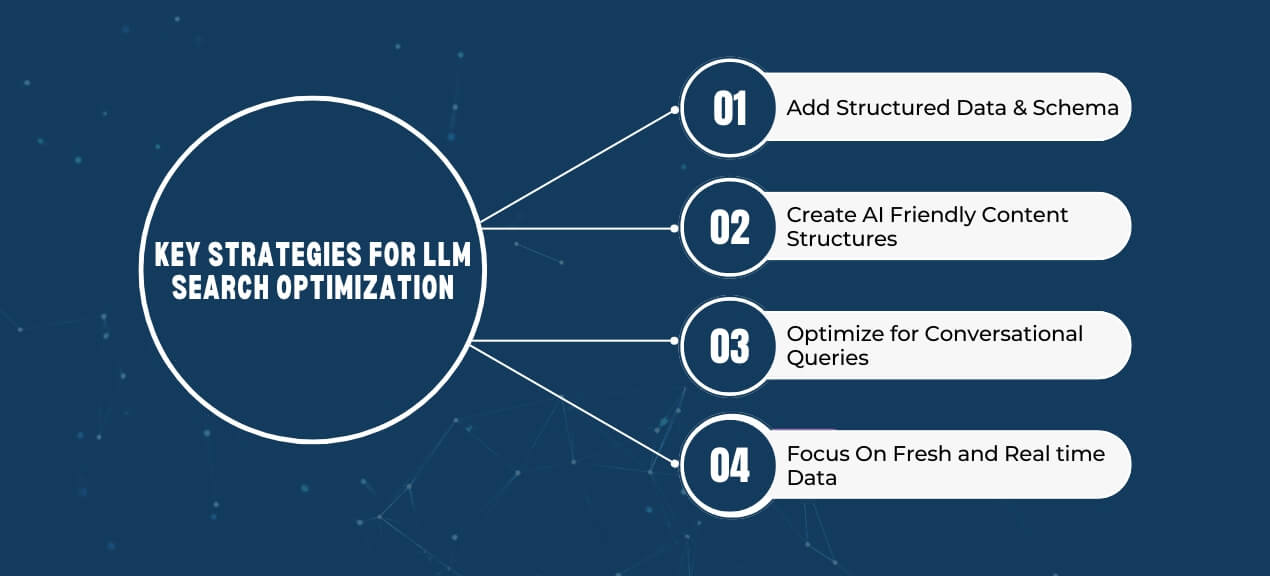
Search has undergone major evolution. Now people ask long questions through search engines. They expect to get an answer that contains all the necessary information. With the advent of AI search, this process became even quicker. People ask one question and get a full response to it, which includes information from several sites. It gives businesses a new opportunity to get visibility. You need your site to satisfy both people and AI. Here comes LLM SEO into play.
What Is LLM SEO?
LLM SEO stands for Large Language Model Search Engine Optimization. It involves optimizing your website content in relation to the capabilities of the large language model AI system. Your site needs optimization to make sure that the AI understands your website, topics, service offering, product offering, and expertise. It does not simply involve creating content for the machine. It involves creating clear content that people can quickly understand. People’s ability to understand content provides more information for the AI system to process. The importance of traditional SEO cannot be ignored since search engines still depend on good SEO fundamentals. LLM SEO provides one more layer on top of that SEO strategy. It involves providing contextual and relevant information through natural questions and answers.
How LLM SEO Works
LLM SEO requires precise information. The AI requires information for context in order to know what you have on your website. Information such as your subject matter, the purpose of the website, target audience, and other pertinent information is essential. Service pages should provide context about the problem and solution. Product pages should give context about the product itself and its various features. Proper structure also assists in the connection of ideas through the provision of context.
LLM SEO vs Traditional SEO
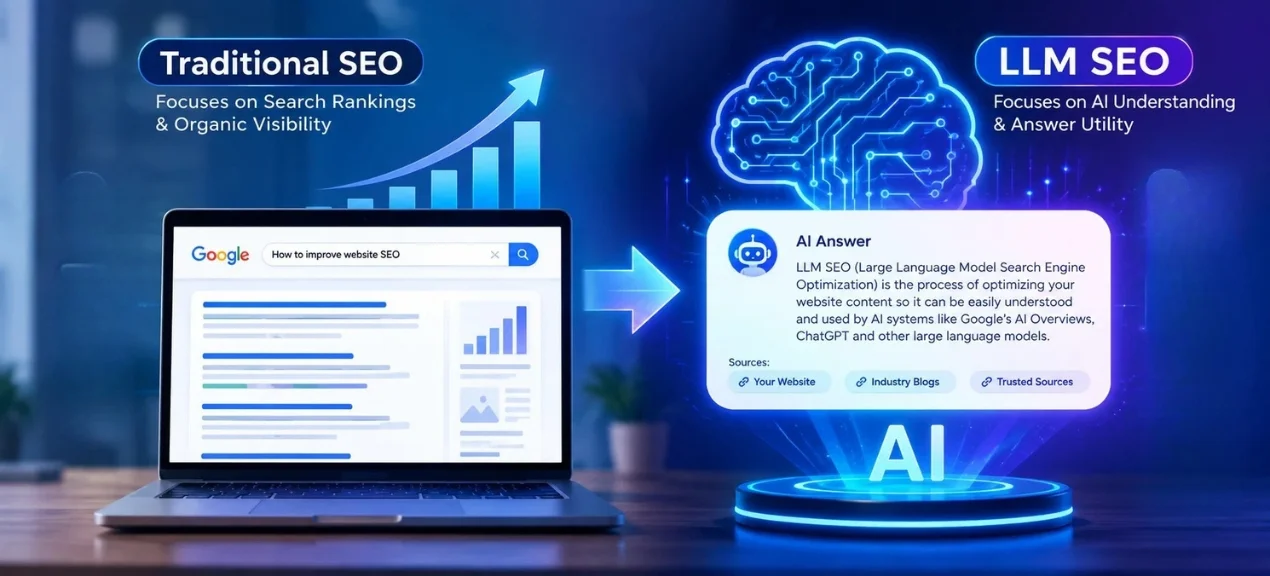
The traditional SEO is primarily concerned with the organic search presence. The LLM SEO emphasizes AI understanding and answer utility in addition to organic SEO. In both SEOs, the requirement of good content, structuring, keywords, and access remains the same. Traditional SEO tends to display multiple website results. But the AI-based search displays one result generated from multiple sources. It means that your webpage should have information that stands on its own.
Why Does LLM SEO Matter?
The reason LLM SEO is important is because the way people search has changed. Now, people are using artificial intelligence to do research on the products, services, brands and even topics. They pose a question prior to going to the site. In some cases, users can come to a decision based on the response provided by the AI. This brings yet another level of visibility for companies. You can be used as a source within the response provided by the AI and gain the attention of users who need more info.
The Rise of AI-Powered Search
An AI search provides a user with a different way to get information. Rather than having to open several pages of results, users can ask a single question that is detailed. An AI is then able to categorize information to create an answer to the question. There are AI search experiences available on Google as well as other platforms using AI for their searches. This opens up a whole new world of visibility possibilities for websites.
The Growth of Zero-Click Search
Zero click search occurs where users get enough information without clicking through to any website. The use of AI for answering questions increases such instances since people will have their answers directly served to them. It may decrease the number of clicks. It can however improve the exposure of your brand, since someone may click on your site after viewing your name or logo in one of the answers. Some people might click through to find more information.
How AI Search Is Changing Website Visibility
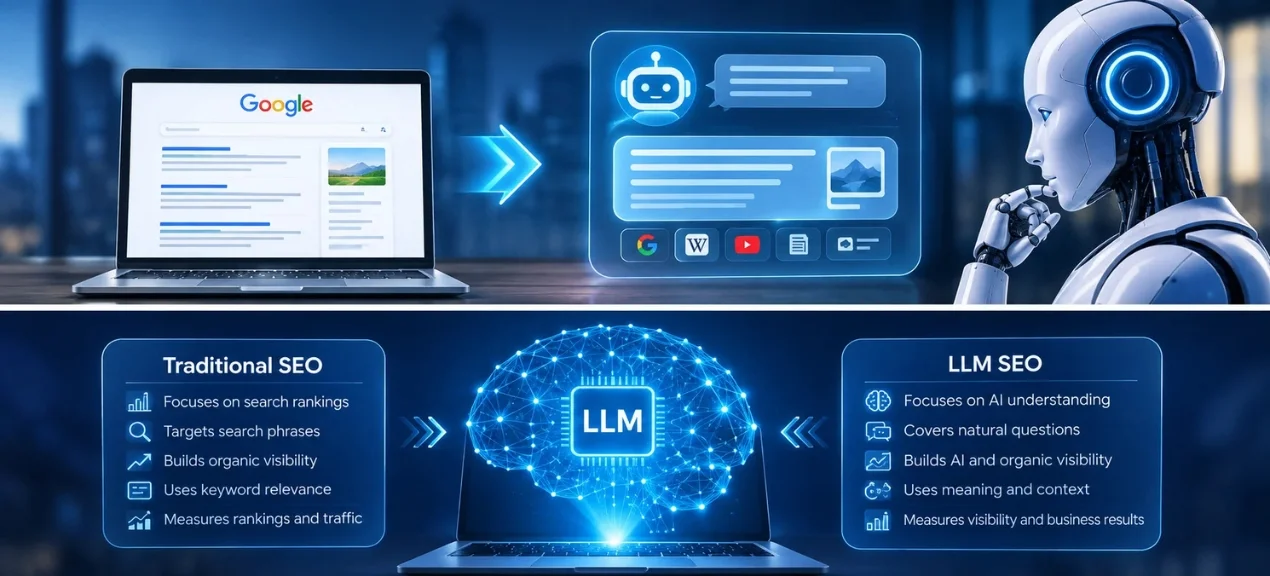
In the world of website visibility, things have evolved beyond ranking. The page could rank in conventional search, as well as be used for answering an AI query. A company could also become a part of product comparisons or recommendations. This affects the way the company should evaluate its SEO performance. Ranking remains crucial; however, it is not everything that matters. Brand visibility, qualified traffic, lead generation, sales, mentions all these should be considered too.
| Traditional SEO | LLM SEO |
| Focuses on search rankings | Focuses on AI understanding |
| Targets search phrases | Covers natural questions |
| Builds organic visibility | Builds AI and organic visibility |
| Uses keyword relevance | Uses meaning and context |
| Supports search results | Supports AI answers |
| Measures rankings and traffic | Measures visibility and business results |
How to Optimize Your Website for LLMs
SEO for LLMs begins with creating valuable content. The pages of your website should provide answers to questions in easy to understand language. Each part should give a specific reason why people should continue reading further. The structure is necessary both to make it easier for users to find information and to help LLMs understand your subject matter and its context. You should think about answering questions rather than just using keywords.
Create Clear and Conversational Content
Write like an expert speaking to a real customer.Make use of short phrases and basic language. Prioritize answering the primary question. Then explain the reasons or details and choices. Avoid vague claims and repeated phrases. Natural wording helps readers understand your message quickly. It also gives AI systems clearer information about your subject, service or product.
Structure Content With H2 and H3 Headings
Good headings establish a clear content path. H2 headings must be used for main topics and H3 headings for sub-topics. All the headings must clearly convey the content that is going to be provided under them. Do not use creative headings that confuse the topic being addressed. Such headings make it easy for people to navigate long web pages.
Add FAQs and Key Takeaways
FAQs can be used to answer common queries of the consumers prior to buying. It can include pricing, quality, delivery time, maintenance, appropriateness, and distinctions between the products. Provide answers that are straightforward. Don’t create queries just for the sake of keywords. The key takeaways can also assist consumers in recalling the vital information.
Use Semantic and Natural Keywords
Contemporary searches comprehend meaning beyond keyword matching. Use associated words that fit into your theme in a natural way. For instance, on a page about ceramics coating, you can mention paint protection, glossiness, durability, and surface preparation. The use of these words will add context to your content. Use your keyword naturally when it is necessary.
Demonstrate E E A T and Original Expertise
A professional website displays genuine expertise rather than just making false claims. Provide an explanation of your procedure, materials or expertise and customer concerns. Use real world examples wherever possible. Unique information is valuable and difficult to reproduce. One who conducts repairs can explain their mistakes. One who sells products can explain the rationale behind their product selection.
What Is llms.txt and How Does It Help?
llms.txt is a file that can be used by websites. It will give the language models an easy-to-understand guide of significant information about the website. The file may include information that leads users to helpful pages, guidelines, documentation, and resources. But it should not be used as your primary SEO technique. It does not substitute good content, technical SEO or robots.txt and Sitemap.xml.
What Is llms.txt?
llms.txt is a proposed Markdown file for websites. It normally sits at the website root. It can include the website name or a short description and links to useful resources. The idea gives AI systems a simple content guide. However, adoption varies across AI systems. It does not guarantee visibility in AI search. Strong content remains the more important priority.
What Should an llms.txt File Include?
Useful llms.txt files will be concise and brief. The first line to use is the name of the website and the description. After that, you can add the links to the useful resources. It may be anything from product documentation to service pages, manuals, and descriptions. But you should not add all the websites URLs; pick the useful ones only.
llms.txt vs robots.txt vs Sitemap.xml
The function of these files varies. Robots.txt gives commands for crawlers. Sitemap.xml enables search engines to find website URL’s. llms.txt gives suggestions on what is considered helpful information for language models. These files cannot replace one another. It is essential that the owner of the website is aware of the different functions of these files.
| File | Main Purpose | Role |
|---|---|---|
| llms.txt | Guides AI systems toward useful resources | Optional AI resource |
| robots.txt | Provides crawler instructions | Technical access |
| Sitemap.xml | Lists important website URLs | Search discovery |
How to Create an llms.txt File
All that is needed for the creation of llms.txt is the simplest of Markdown. Start with the name of the website in the title. Describe the website in a few words. Give links to all the useful sources. Stick to brevity and facts in the file. Check all links before posting the file online. Place the file in the website root folder. Update the file whenever there are important changes on the website.
Frequently Asked Questions About LLM SEO
What Is LLM SEO?
LLM SEO stands for Language Models Search Engine Optimization. This form of SEO assists in making it easier for the AI to comprehend your topics, services, products, and expertise. Good LLM SEO makes use of quality responses, natural language, helpful context, and proper formatting. It works along with SEO and not as a replacement for it.
Is LLM SEO the Same as Traditional SEO?
No, but there are certain similarities between these approaches. Traditional SEO centers on search engine ranking and visibility. On the other hand, LLM SEO emphasizes more on AI comprehension and relevance of the answer provided. Both approaches require good quality content, appropriate keywords, proper structuring, and access. This is because of the way information is delivered to the users.
What Is llms.txt?
llms.txt is the suggested Markdown file for websites. This file can be used to direct language models towards valuable website resources. The file will contain website descriptions and links to valuable pages. These pages will have guidelines, documentation, products, or services. However, llms.txt is not meant to ensure that the AI has visibility. It will also not replace robots.txt or Sitemap.xml files.
Does llms.txt Improve AI Search Visibility?
It is uncertain whether the use of llms.txt helps increase visibility in AI searches. It may be treated differently by different AI software. Google does not need llms.txt in order to perform its AI search function. Web developers should therefore concentrate on building a better foundation in terms of SEO.
Is llms.txt the Same as robots.txt?
No, because they are used for different functions. Robots.txt is used for providing guidelines about crawlers’ access while llms.txt gives guidelines regarding useful information on websites. Sitemap.xml is used for a completely different function. It is used by search engines for locating URLs on websites.
How Can I Optimize My Website for ChatGPT and Other AI Search Tools?
Use content that answers questions that customers ask. Create titles and descriptions that are clear and concise. Give attention to the details rather than stating obvious facts. Include unique examples and insights based on experience. Make sure that critical pages can be indexed by crawlers. Create internal links to relevant pages. Make sure the data about your company is correct. Focus on helping people make better decisions.
Final Thoughts
LLM SEO has emerged as one of the most important parts of contemporary search strategies. The emergence of AI technology has changed the way users look for information, products, and services. Now they can ask very detailed questions and receive immediate responses. All these factors create new opportunities for businesses with helpful websites. But LLM SEO is not a replacement for traditional SEO practices. It is still necessary to have solid technical foundations of your website. It is still essential to have clear and understandable content. It is still critical to use internal links. And it is still very important to ensure search accessibility. The only difference concerns the way information is delivered to users. It may be presented in the form of a regular search result. Or it may be used as a source for an AI response. Thus, information becomes especially important. Businesses need to pay attention to helpful answers to questions. Products must be explained through helpful comparisons. Services must be described with helpful information. Experience needs to be demonstrated rather than proclaimed. And all important information must be accessible to users. llms.txt may offer one more approach to the organization of resources on your website. But you should not base your whole strategy on one emerging file type. Create a website worth visiting first. Make its information accessible later.
The Future of SEO Is AI-Driven Search
The future of SEO will be further evolving with advancements in AI search. Users will be asking longer queries and expecting better responses. They will be comparing products through dialogue. They will be researching services before reaching out to organizations. They may even use several different AI tools before making decisions. This makes the creation of original website information ever more important. Generalized content will be less important as AI will be more efficient. Specialized knowledge will be more important. A comprehensive explanation will be more important. Comparative analysis will be more important. Thorough topical content will be more important. Organizations should not resort to the creation of numerous web pages. Rather, they should create fewer pages but with greater information. Every page should be designed to solve some type of search query. Every page should provide an answer using simple and informative language. Every page should give readers sufficient information to make better decisions. Traditional SEO will still be an important part of this future. LLM SEO will bring about yet another layer of visibility for websites. The most effective approach is not to try to embrace all trends. First of all, earn trust with valuable information. Next, make the website readable and understandable. Then supplement this content with strong technical SEO. The technology of searches will continue to evolve. Valuable information will remain important. Answer-giving websites will remain important.