
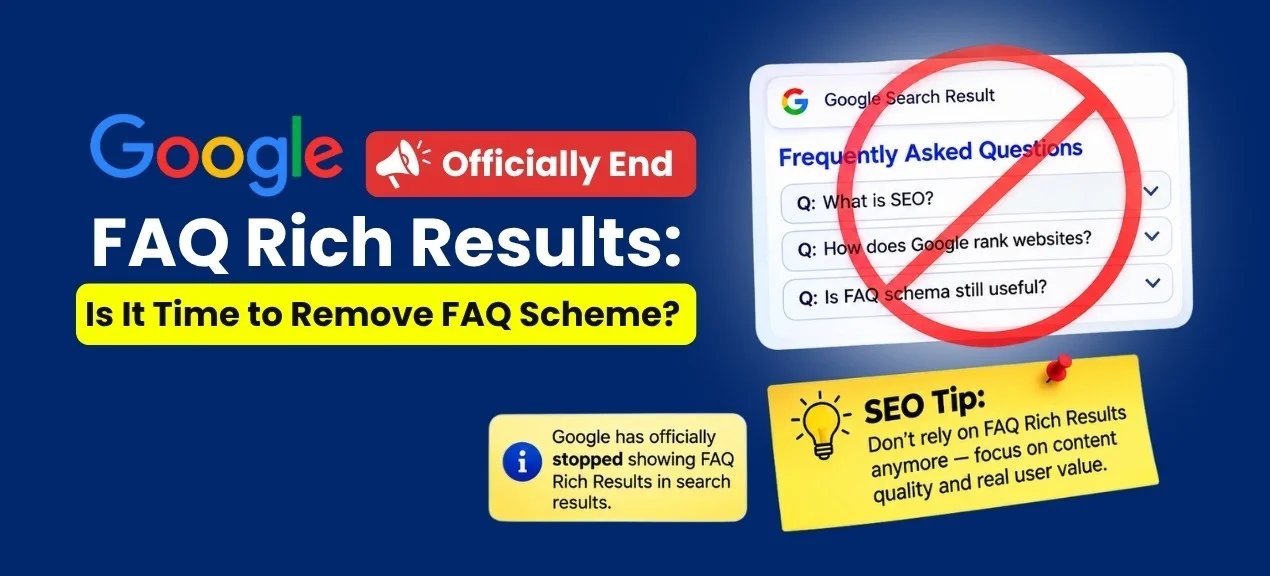
Google has revolutionized the search process for countless websites. In the past, many businesses had to use FAQ rich results in order to get additional visibility in search results. These rich snippets provided additional chances for attracting more traffic and building credibility. Now there is no chance of utilizing these opportunities. Google currently restricts the display of FAQs from a select number of trusted websites. This move has compelled companies to examine their SEO approach. Now many website owners face a similar problem. Do they have to get rid of the FAQ schema or not? The answer varies depending on your website’s needs.
What Are FAQ Rich Results?
Frequently Asked Questions rich results show questions and answers right within Google Search. Such results usually show up below an ordinary search result and provide users with information instantly without clicking through to another page. Frequently Asked Questions rich results are generated based on FAQ schema, which is a kind of structured data. Website owners include such code on pages containing questions and answers. When Google detects that code, it can understand that page better. When the page corresponds to the quality guidelines of Google, it can feature these questions within search results. Such extended search results can get more attention than usual. Lots of companies utilized FAQ rich results for these reasons.
Why Did Google End FAQ Rich Results?
Google aims to maintain clear and helpful search results. . In the course of time many web pages have started adding FAQ schemas with little to no relevance. There were repeated questions with no value for users, and other pages were creating FAQs just for gaining more search area. This approach decreased the quality of search results.
Furthermore, Google has improved its understanding of page content. It does not need FAQ rich results to understand relevant data anymore. The corporation pays more attention to content quality, page experience and user experience now. Search results should contain answers to genuine questions and not various extra elements.
Also, Google is trying to find information in trusted sources. Official information can be found on government websites and health organizations websites. Such websites will be prioritized for FAQ rich results now. Commercial sites rarely have such an opportunity now.
Such a move does not decrease the importance of structured data. Google still analyzes website content through schema. The main change concerns search results’ appearance but not website content understanding.
Who Is Affected by This Change?
This change has affected almost every commercial website. eCommerce sites, local businesses, services companies, agencies, publications, and blogs now lack FAQ rich results. Websites using correct FAQ schema do not have these rich search results anymore either.
There were many industries that used FAQ rich results to improve their online presence. Law offices answered legal questions; roofing companies gave answers regarding their usual services. Marketing agencies provided information about SEO, and eCommerce websites published product details. Nowadays, all of these websites usually show up in regular search results.
Government websites and reputable health organizations are the only exception. These types of websites still enjoy the privilege of FAQ rich results as their content provides useful information to people.
It will be difficult to restore FAQ rich results anytime soon. Google has clearly shown its stance on this matter. In the future, SEO will depend on high-quality information rather than other additional features.
Best Practices for Using FAQ Schema After Google’s Update
FAQ rich snippets are no longer available from Google on most sites. This does not mean the FAQ schema is obsolete. Following Google’s Structured Data Guidelines will help search engines better comprehend your content. FAQ schema markup should be applied only when your page contains actual questions with truthful answers.
Each question should serve the user intent. Each answer should address a real issue. There is no need to include filler content to satisfy search engines. It’s better to use information about your products, services, or experience.
The location of FAQ should correspond to user expectations. Product pages need to provide buying details. Service pages should describe the service, provide price information or timelines. Category pages will help users to compare different variants before a choice.
Answers should be clear and use plain language. Each FAQ should be direct and provide useful information. Updates are needed any time you update your products or services.
FAQ schema should not be treated as a tool for improving ranking. Quality content and structure together with informative information are much better for SEO than rich results.
Common Mistakes to Avoid After Google’s Update
Most website owners delete all their FAQ pages after Google’s update. Such an action negatively affects user experience. Relevant questions still provide additional value, regardless of rich results.
An additional mistake made by website owners is using outdated answers. Old information confuses users and makes them doubt your business. You should check all your FAQs periodically and change those that are irrelevant.
Many websites have duplicated questions on numerous pages. Such content provides no value to the page at all and lowers its quality. The questions on each page should be relevant to its topic.
A lot of websites use FAQ schema for questions that are not visible on the page. This is another mistake because it breaks consistency and affects trust. Your structured data should be consistent with your page content.
Do not create too large FAQ pages filled with unnecessary questions. Each of them should solve some problem of your customers. Quality is always better than quantity.
Should You Remove FAQ Schema from Your Website?
The way you use it determines the response. Do not remove FAQ schema without good reason. Search engines still read structured data to understand what is on your page. This advantage is very useful for your SEO in the future.
Do not remove FAQ schema from pages that contain useful questions and answers. Product pages answer the questions about shipping, return, warranty, product features, etc. Service pages cover pricing, timeline, process, etc. All of them will enhance the user experience, even without rich results.
Remove FAQ schema from pages that have poor or repetitive content. Get rid of useless questions. Do not create content for search engines. All FAQs should be useful for your topic and help users make right decisions.
Think about your audience before ranking. Useful content builds trust. Trust helps build better engagement. Better engagement helps with better SEO in the future.
The update of Google makes FAQ schema different in search results. However, this update does not deprive it of the opportunity to help search engines understand your website. Everything starts with quality.
How Businesses Should Adapt Their SEO Strategy
It is time to stop pursuing features for the sake of search and create authority. Google currently favors websites that answer actual questions using relevant information. Every single page should be addressing a question or supporting a purchasing decision.
Write detailed services pages that have original information. Write product pages with useful information. Create content based on your experience and expertise. Let users know what makes you better than your competitors.
Improve internal linking structure. Speed up your site. Make every page readable. Update outdated content with new information. Pay attention to useful topics rather than quick fixes for your SEO efforts.
Structured data is important and should be used properly. Combine structured data with good content and website structure. Such a combination will help you to get better visibility online.
Final Thoughts
This is the most revolutionary step taken in modern-day SEO. FAQ-rich results do not offer the same competitive edge to many websites anymore. Accept the update and start focusing on content.
Success should not be defined by the addition of another search feature. Success will be defined by useful content, trustworthy content, and successful business. Keep your FAQ schema where it is relevant. Delete it when it is irrelevant.
The future goes to those who first help others. Create useful web pages. Provide answers to questions. Give useful information. Such a content strategy will keep you competitive despite Google updates.