
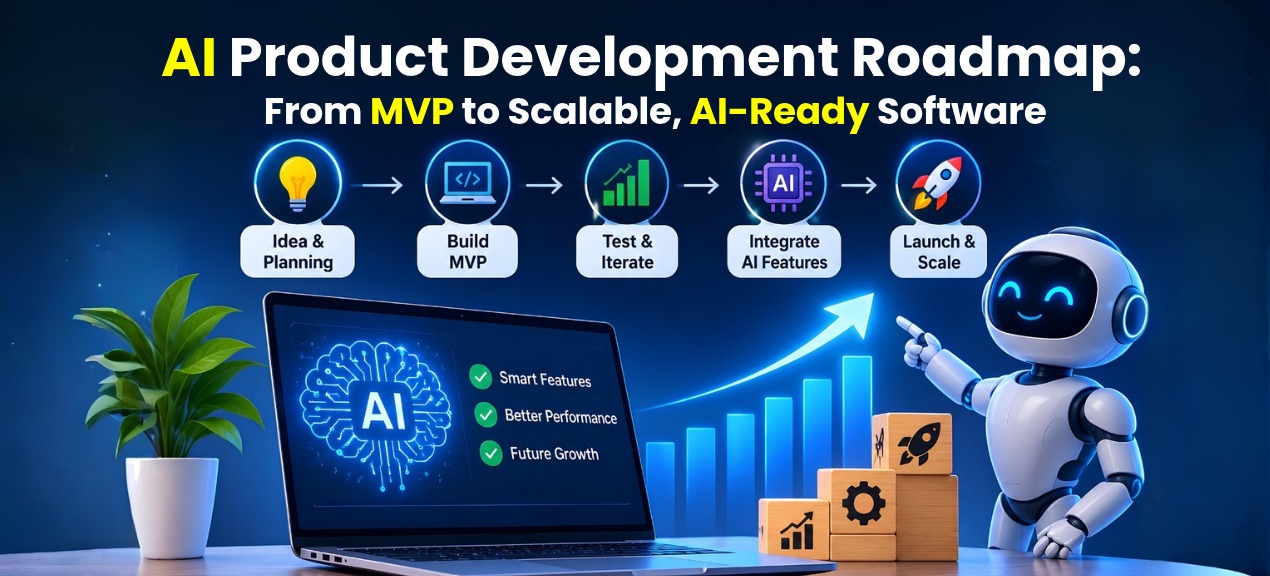
The development of AI products aids firms in transforming a basic software concept into a wise and scalable solution. There is an effective roadmap for each phase starting from creating MVP until launching the full product. It enables them to select the appropriate technology and enhance the performance of the product. They can easily integrate AI features in their products and deal with growth in the future.
Introduction: From MVP to Scalable AI Product
There is no such thing as a successful software product without having a clear vision of what you want to achieve. A business might need to solve customers’ problems and provide additional services. One of the main steps of the process is creating MVP which allows you to understand whether your ideas are feasible with the help of actual users. Nevertheless, one needs to keep in mind that not only a good beginning is needed for the further growth and satisfying customers’ needs.
A lot of trouble occurs when there are many more users and they require additional features. A simple system might work fine at the very beginning but will fail at some point because of increasing load on it and growing complexity of tasks. This is why a proper AI product development roadmap is crucial since it helps a team to plan all the stages of the development from MVP till reliable and scalable software product.
Why Do MVPs Struggle to Scale?
It is possible that an MVP will work fine when there are just a few users but as you grow or you will start noticing various issues that need addressing. Inadequate coding and poor architectural structure will affect the ability to add future improvements. More users will mean more cost for servers.
Technical Debt and Architecture Limitations
Fast development can result in bad coding and bad system design. Development of new features will then take longer time to develop. The team has to correct the previous code before they can add new features to it.
Growing User Demands and Infrastructure Costs
There is also an increasing demand for speed and reliability. Higher traffic levels may result in higher costs of maintaining the servers. Use of AI requires additional payments because of API calls and tokens.
Integration and Performance Challenges
Sometimes growing products require the use of payment systems and API integrations. If not integrated properly, it will lead to errors and delays. There is also a need for proper data flows within AI components.
What Is AI Product Development?
The product development process based on AI involves adding intelligence to software that can be used to improve the efficiency of searches or provide superior customer service by interpreting data more effectively. Organizations can adopt AI to reduce human efforts and improve the user experience. An AI system needs to solve a problem.
Understanding Large Language Models
Large Language Models have the ability to comprehend and generate human language. They assist software programs in answering queries and summarizing text. Products can incorporate LLMs to provide support in chats and improve search functions. The output from LLMs is dependent on the quality of data fed to them.
How LLMs Accelerate MVP Development
LLMs enable developers to quickly generate and test their ideas via code. They also make it possible for teams to build basic AI functionality using APIs. This makes it easier for them to test the value of their products. Developers need to ensure that the code is of high quality and secure.
Benefits of AI Integration in Software Products
The usage of AI can lead to more efficient software that is easy for users to use. Intelligent search will help to get answers faster. AI-powered assistants will be able to answer routine questions from customers.
How to Build an AI Product Development Roadmap
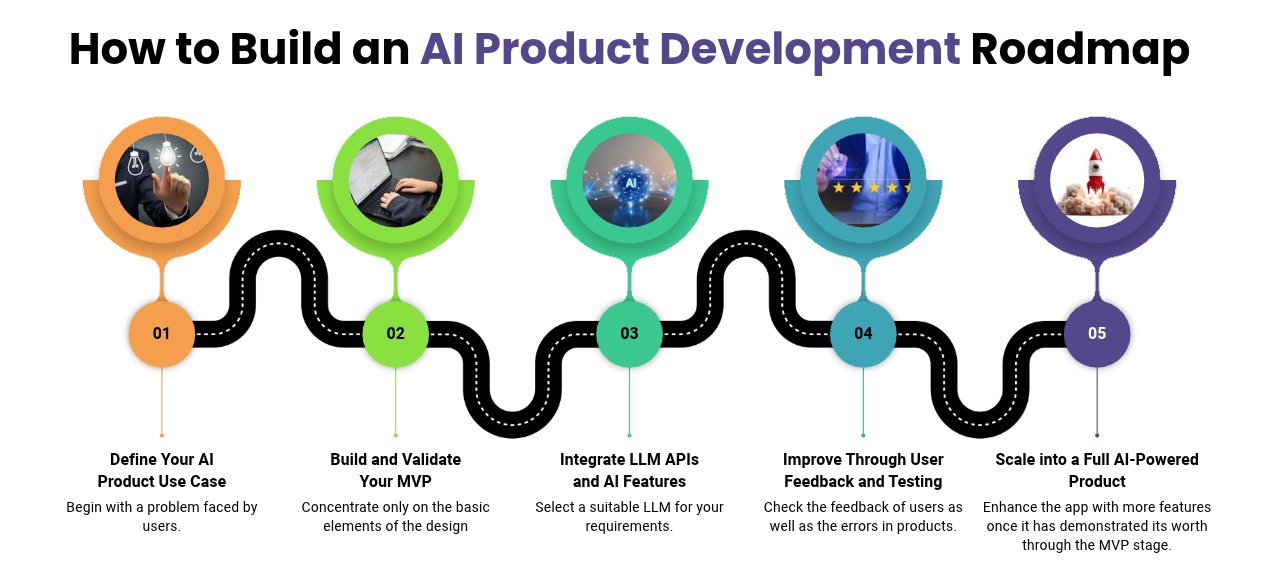
Roadmaps ensure that product vision aligns with technical requirements. They help teams plan how each phase or starting from the initial idea up to the final release will be done. Each phase must have its objective. Testing and user feedback can help with future planning.
Define Your AI Product Use Case
Begin with a problem faced by users. Look into the needs of customers and the gaps existing in the market. After that, find out where there is scope for using AI.
Build and Validate Your MV
Concentrate only on the basic elements of the design. The product should be user friendly. Present the prototype to real users and take their feedback. Use the feedback to create a better product.
Integrate LLM APIs and AI Features
Select a suitable LLM for your requirements. Integrate the same via an API and implement one beneficial feature. Fix boundaries around user queries and model answers. Test the feature prior to deployment.
Improve Through User Feedback and Testing
Check the feedback of users as well as the errors in products. Verify the AI’s replies with genuine questions. Check for speed, accuracy, and costs. Improve the weak areas before every release.
Scale into a Full AI-Powered Product
Enhance the app with more features once it has demonstrated its worth through the MVP stage. Enhance server capacity and database capacity as the traffic increases. Security and performance should remain key considerations during each update cycle.
What Makes Software AI-Ready and Scalable?
AI compatible software can incorporate new frameworks and technologies with minimal system modifications. This requires a robust architecture or good security at the APIs and data level and scalability. Scalability refers to the ability of the system to accommodate additional users without compromising its stability. This forms a solid foundation for growth.
Scalable Software Architecture
The proper structure helps make any future changes easier. The developers must split the system into easily manageable components. Each component should have its own function. It prevents mistakes and promotes product development.
API Integrations and System Flexibility
APIs enable software applications to interact with outside services. They permit the integration of products with payments and AI algorithms and database management. Good API regulations increase efficiency in data transfer. Systems that are flexible will make future upgrades easy.
Performance and Infrastructure Optimization
Quick software provides for a better user experience. The team needs to look at the server loads and response times. The cloud can be useful in managing the traffic.
How Do LLMs Help Scale AI Products?
The LLMs assist products to manage their textual tasks and customer queries. This includes intelligent searching and customer service. Choosing the appropriate model will ensure better performance in speed and accuracy. Cost and data control are additional considerations for the team.
Prompt Engineering and Model Customization
Well designed prompts allow models to understand the task at hand. Teams need to create easy to understand prompts and guidelines. Prompt testing needs to be done on user questions. Good prompts will improve answers.
Fine Tuning and Retrieval Augmented Generation
Fine tuning enables the model to do a particular task. RAG allows a model to have external sources. It uses the documentation and manuals of the company to answer questions. It enables the product to provide more relevant information.
AI Model Selection and Cost Optimization
Not every task assigned to the AI requires a big model. Small models will work on simple tasks at low cost. Big models will perform complicated tasks. People should make a comparison among quality or speed and price.
Best Practices for Scalable AI Product Development
Effective development processes make it easier for teams to create quality software. Effective development processes also lower the risk of future problems and costs. Businesses need to prioritize data security and testing. This is an important part of the process.
Start with Quality Data
When there is good data, AI can produce meaningful outputs. Errors and outdated information need to be eliminated from the database. Good data will improve the performance of products.
Prioritize Security and Responsible AI
Never disclose any personal information of the user or any business-related information. Make sure that the APIs used are safe and there is proper access control mechanism. Analyze the findings of AI to verify that there is nothing wrong.
Monitor AI Performance and Costs
Monitor response times and calculate cost models. Evaluate mistakes and answer quality. Establish usage limits to contain costs. Periodic monitoring helps ensure product quality.
Build Flexible and Modular Architecture
Keep the system components distinct and updateable. Do not have rigid connections with one AI supplier. Employ flexible APIs and coding guidelines. This will facilitate future modifications.
Continuously Improve AI Features
Consider user comments following each release. Test out new prompts and models. Address any problems impacting the user experience. Even small changes can yield great outcomes.
Conclusion Turning Your MVP into a Scalable AI Product
The MVP is the first stage of testing the ideas for the software. But long term success demands more than just the implementation of a useful product with limited features. A team will need to have a proper roadmap that takes care of the architecture, data and AI integration and system performance as well as the understanding of users and costs as the product evolves.
A good AI product development process requires the approach that prioritizes value over technology. It should start with finding the right use case and then testing the MVP without adding complex features. A good design of the system will allow future updating of the models and scaling of the product as well as its quality improvement based on testing and feedback.