Blog | HaddockSoft

A Complete Guide to Influencer Marketing

What Is Influencer Marketing

From one to ten influencers, most marketers who have an influence program work through 2026. Creative content created by an influencer is often overly branded and may be controlled by brands. Why? An influencer’s audience may detect slight variations in content style, which could compromise their authenticity and the success of a campaign. Creative control and freedom of style are both options for influencers, as suggested by brand marketers.

Who Can Use Influencer Marketing?

People have the ability to apply shareable content in their personal, friends’ lives, or current events. It is desirable that shareable content is both useful and timeless. A product review may not be shared and viewed for longer than a thematic “How-To” video that uses referring products. By setting the content and quality standards, brand marketers can ensure a piece’s well-produced outcome. This is crucial. Impressions, views, comments, shares, and reach are typically measured by high levels of sponsored content, indicating the success of an influencer campaign.

Why Is Influencer Marketing Important?

Reach being viewed as the most reliable indicator of an influencer’s quality is one of the biggest mistakes in Influencer Marketing. Why? Only by evaluating the follower count and other vanity metrics, brand marketers often hire social influencers.

Emphasize Creating Shareable Content vs. Overly Branded

Brand marketers frequently sabotage their own campaigns by placing excessive demands on influencer’s content. Their unique voices have helped them establish connections with their audience.’

Use a CTA that is both effective and uncomplicated

Despite the fact that marketers should provide influencers with touch points and campaign messaging, a strong call to action (CTA) is arguably the most critical one. An influencer’s audience can be captivated by a CTA, which can take several forms.

The use of CTAs can take the form of an influencer offering a loyalty discount, introducing perks, or providing viewers with positive feedback on their brand exploration. CTAs should be prominent and clear in the content integration to attract viewers. A CTA should be present at the start of a sponsored video by an influencer, or it can be included in the content’s title.

A brand selects a CTA and may seek the assistance of an influencer marketing agency for guidance on the most effective strategies.

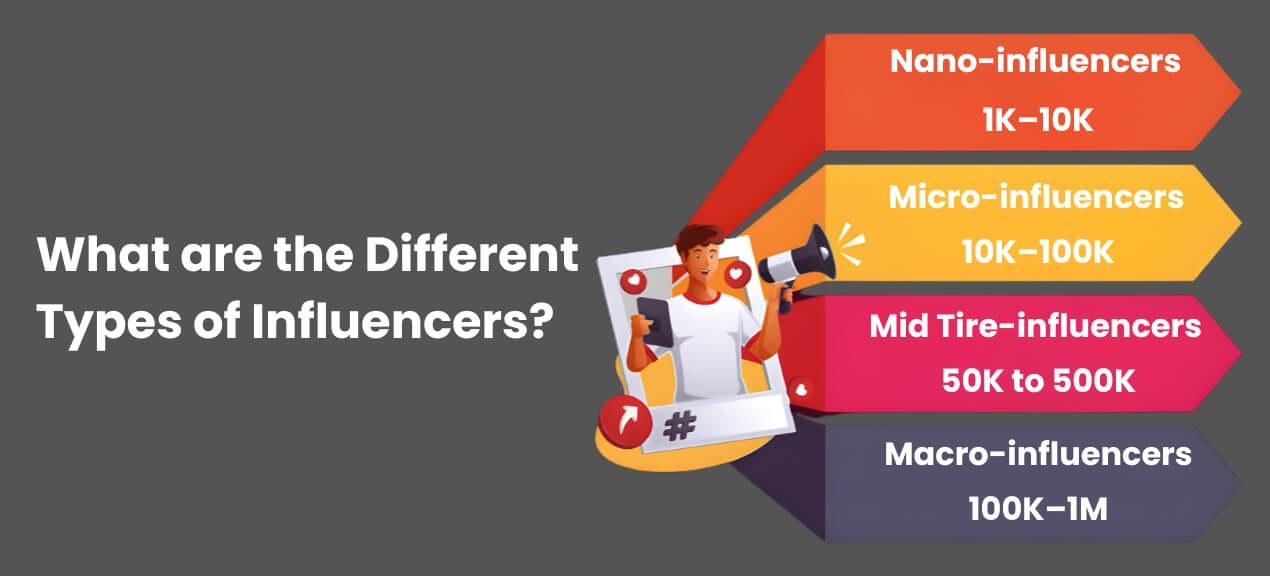
What are the Different Types of Influencers?

Macro-influencers

If you’re looking for a way to make your product stand out without spending money on Cristiano Ronaldn (headed to IG for an estimated $2million), consider using macro-influencers. They can be very useful.

Most of them are always working on their brands and making fresh content regularly. Moreover, they stand out from the rest in terms of content creation. Your product and/or brand will be more visually appealing if your micro-influencers can hire professional photographers. Why?

With macro-influencers, you can have a single campaign and contract, unlike other influencer types who run numerous smaller campaigns.

Keep your head down easier.’. They’re all connected, but you need to have a willingness to spend some serious money to work with one of these individuals.

What’s a Mid-Tier-Influencer?

A micro-influencer would have anywhere from 10K to 500K followers if Jan were not present, unlike how it was previously understood in the context of talking about just micros and mega-ins. I can tell you this: It’s not rocket science that an influencer will have a slightly different life than someone with 10K followers, but they definitely have 500K following. Since brands are interested in partnering with influencers that have a following of 100,000, we’ve chosen to adopt Jan and add her to our official list.

The audience engagement and authenticity of mid-tier-influencers make them atypical. An influencer with a larger following and wider reach can be advantageous for brands, as it offers them both financial benefits and the opportunity to partner with their brand in mid-tier. These guys have more experience than the ones below, resulting in better pictures and content. Why? Joining forces with a mid-tier influencer will result in successful sponsored content and measurable ROI. #goJan.

Business, as we all know, involves gaining more experience at a higher cost. Those who seek a balance between cost and benefits are at least the right influencers.

Micro-influencers

Everyone desires to be acquainted with and establish friendships through micros, the upcoming social media stars. What’s the rationale for their low-cost and in-depth understanding of trivial matters?

Despite this seemingly great idea, micro-influencers are believed to have restricted reach and as such may not be the best fit for brand awareness campaigns where wider reach is more desirable.

During the same time frame when influencers are inclined to purchase their followers, engagement will decrease. As a friend, I am aware of this.

What’s a Nano-Influencer?

You know, influencers have a duty to exert an impact and attempt to influence. Keep in mind the popular pages on the gram before embarking on your search. They’re now called Explore. However, you’re examining the Instagram algorithm’s consensus of what is popular.

How Much Do Influencers Cost?

Various levels of benchmarks in the creator economy today are subject to ongoing changes. For those who want to charge as an influencer and build on their data, check out these ranges.

Those who follow Nano (1K–10K followers) are the least following. Why?

Story and single posts may require a competitive entry fee from them. This location often charges flat fees that are relatively low.

They usually offer substantial flat fees for each Reel or as part of bundled packages. More is typically required when experiencing a higher ER. 8,000 to 40,000 is the approximate cost of each project. The charges are quite high.

They have a following of 100K to 500K and are well-known as big creators in their respective fields.

These packages are often bundled with additional charges and have a higher production value. Each project costs around 40,000 to about 80,000 dollars in total.

This category includes Macro followers who have a large following and demand content-based pricing, as well as significant licensing for reuse by the Creatos.

Their popularity is widespread across the nation, with campaigns priced at 1,50,000 to around 20,000 to 40,000.

Internationally, this category includes mega / celebrity figures with over 1 million followers.

Their fees account for both mass awareness value and premium usage rights.

Steps to Start Influencer Marketing

  • Follow the influencers/thought leaders you are already acquainted with and follow accordingly. We enjoy utilizing outreach tools like Woodpecker. In the event that I am familiar with a person working for their company, but may not have their email address, Hunter is an excellent tool to locate their contact information.
  • Use the ‘coming soon’ list page to search for celebrities and influencers who are more likely to be interviewed by Amazon. •.
  • The books coming soon list page on Amazon has been a game-changer in my ability to interview successful founders.
  • This permits us to get ahead of the competition as influencers/thought leaders/creators prepare for their book tours, press releases, and interviews. I was able to interview Tony Robbins for his book: Money Master the Game, as evidenced by this.
  • Take note and maintain your follow-up appointments; it can take up to two years.
  • It has been extremely important to prioritize following up and being patient.

Conclusion

This is crucial. Impressions, views, comments, shares, and reach are typically measured by high levels of sponsored content, indicating the success of an influencer campaign.

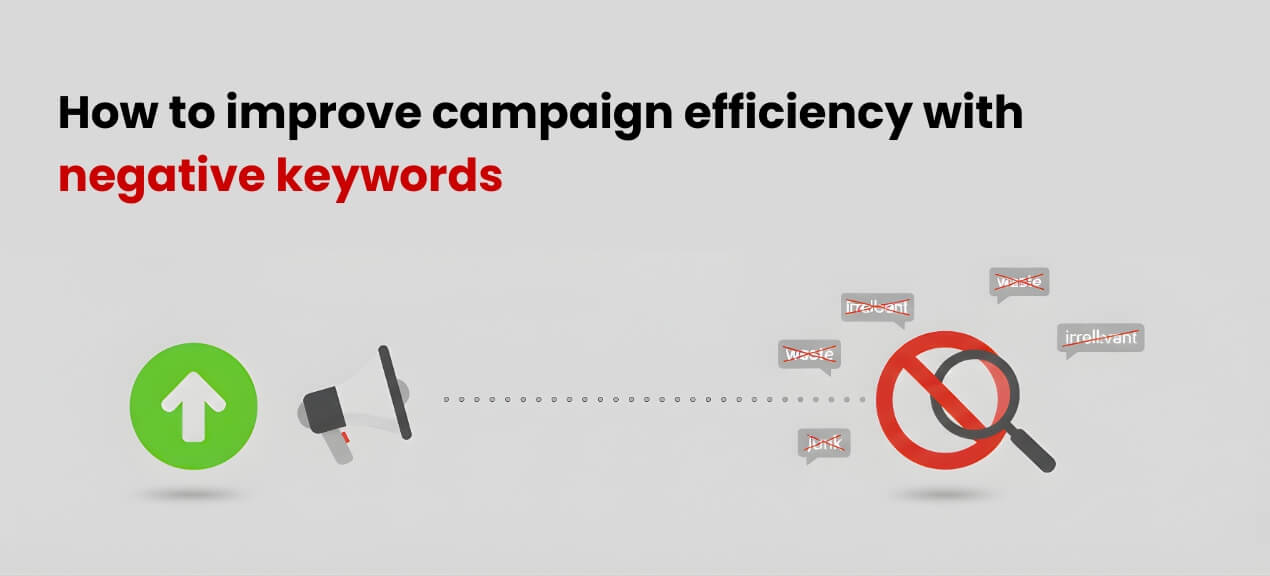
How to improve campaign efficiency with negative keywords

Does the clickthrough rate for your ad campaigns match the quality of the actual traffic? Have you ever felt like your ad spend is filtering into an empty junk pile? Despite the common ad problems, negative keyword optimization is proving to be incredibly useful.

What are Negative Keywords?

We have already established the general concept of negative keywords and their potential to enhance your campaign’s performance.

Consider Negative Words, the same as a bouncer at your online store keeping you from window shoppers and only getting in on VIP experiences.
In the absence of a productive list of negative keywords, Google and Microsoft advertising campaigns become overpriced as they require payment for clicks that never generate revenue or produce desired outcomes. This is where Negative Keywords come into play.

Negative Keywords can help you avoid unnecessary clicks and save money on useless ad campaigns.

By using negative keywords, you can optimize your search and we’ll show you what can happen if you don’t!?

What are the benefits of using negative keywords?

Certain benefits have been highlighted as follow. Why use negative keywords Allow us to expand on the practical applications of negative keywords in your campaign.?

Traffic Control

Does your service offer a course, or are they looking to buy one? One is of great importance, but the other requires a fraction off your budget and has no effect.

Enhance CTR

Eliminating irrelevant traffic on your site leads to increased user traffic. Why? Lowering the frequency of your ads for people searching for less relevant questions is responsible for this. Why? Over time, your CTR will increase if you do it correctly.

Status of CPC

It is natural to expect a decrease in cost per click when you reduce unnecessary traffic and increase CTR. As a bonus, you’ll also get higher ROI! By reducing irrelevant clicks and optimizing for the keywords that are most popular, you can save money on both fronts.

Increased Ad Rank and Quality

Your ads and campaign’s relevance are heavily influenced by the Why use negative keywords you include. The point of your attention is to remove irrelevant things.’ If you use the negative keyword effectively, your ads will only be shown to relevant users, which will result in a higher quality score and better correspondingly improved d rankings. Why? Your dedication leads to the achievement of optimal quality scores and ad relevance.

Levels of negative keywords

Negative keywords that are not relevant to this account level will be applied across all campaigns.

It’s an excellent method for reducing clicks on common search queries that you may have previously ignored.

An entire campaign is covered by these negative keywords. Your ads won’t be displayed for any specific campaign if a negative search term is used, regardless of its size.

The specific ad groups for which negative keywords are applied are the ones affected.

More detail: You can choose to be very specific about your target.e. By using different advertising groups, traffic can be divided into similar but very distinct landing pages.

Red, blue and white are the primary colors featured in a campaign for living room paint colours. By using negative keywords like “blue” and, “white”, you can avoid being shown ads for red colours in the red ad group. Eliminate the target keywords from your negative keyword list and utilize them in other campaigns for a tailored approach. This method is effective.

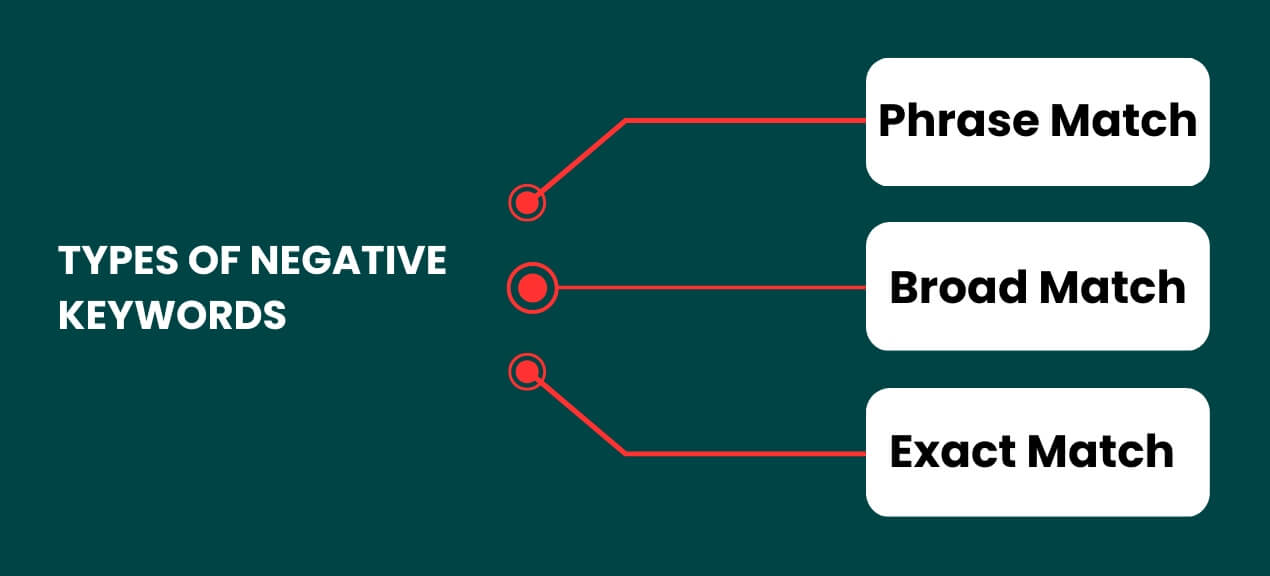
Types of Negative Keywords

Phrase Match

Keywords matching with negative phrases block people who are searching for the exact keyword phrase with additional words that may be included before or after the term. Why is this? ‘Facial and back massage’ or even shoulder massage may be included in your ad, but not for searches like naturopathy.

The safest choice is to use phrase match, as the search query must include the keyword in the text that was searched. This decreases the likelihood of concealing ads from multiple searches while also limiting the target audience for your advertisement.

Broad Match

With broad match negative keywords, you can avoid showing ads for searches that contain all the words in your keyword phrase, regardless of their sequence. Your ad may still be displayed for certain words within the phrase, like ‘running shoes’ or – “you can choose to display your product in these categories.”.

Negative broad match keywords should be avoided as they can limit your reach, even more so than the exact and phrase match negative keywords. Verify the variants have been researched before assigning specific keywords, ensuring that you don’t see any related topics or subjects with the negative keyword.

Exact Match

Search engines that use negative exact match keywords will not display your ad in searches that include the keyword phrase without any variation. When searching for your negative exact match keyword, ‘winter holidays’ only, your ads will not be displayed on search results pages of users searching “wInter Holidays.”. Even if you search for other forms of the term ‘winter holidays’, your ads may still be displayed.

A larger budget provides greater flexibility with exact match terms, but using negative match options like broad and phrase match is more advantageous for targeting the wrong audience and increasing ROI. Additionally, both narrow and term matches are less competitive.

Where to Find Negative Keywords

Observe Low-Performing Keywords

View your search query in Google Ads‘ Reporting section, located under “Reporting” The search results for your ads based on the keywords you’re targeting will be displayed, making it simple to identify negative keywords and include them in your list when irrelevant keywords start appearing.

Adding negative keywords like “in home senior care” to your campaign for hospice services could be a smart move.

To ensure accurate matching, Google does analyze a user’s past searches to identify potential matches.

Increase Keyword Research

Keyword research that relies on seed keywords may reveal keywords that you have no intention of ranking for. When you search for keywords related to the seed keyword, Google may also show your advertisement on a wide range of match setting searches.

Best Practices for Using Negative Keywords

  • Your bidding keyword would be in opposition to your negative keyword if this were done. Verify if any negative keywords are already present in your list and could be hindering your bidding efforts by double-checking. Do this?
  • Segmenting your negative keyword lists is crucial. Organizing your campaign with negative keyword lists can help you stay organized and identify the list to which your campaigns should be linked. Furthermore, by adding or removing negative keywords from a list, it becomes easier to scan for the source of additions or deletions. Refer to our post on 9 types of negative keywords list.
  • Make sure to include the appropriate list of negative keywords in a newly launched campaign. If the list is not chosen correctly, it would be too late to reach its intended audience. Using the appropriate list can lead to increased sales and qualified leads. You can find out more about achieving success with your negative keyword research by reading our post.
  • Finding negative keywords can be done easily with the help of Google Keyword Planner. The process of identifying and adding negative keywords to your list requires manual effort. This process can be time-consuming for those with extensive accounts.
  • You can use an automation tool to save time and money by identifying numerous negative keywords in one shot. The Negative Keywords Tool is an automation tool that can help identify keywords that are not relevant. For accounts with ad spend below $10,000 per month, the tool is now free. Decrease your search ad spend by 10-20% while receiving free content.
  • Avoid re-incorporating negative keywords in your campaign if they have already been included on an associated list. The system can keep track of where negative keywords have been added while minimizing unwanted clutter.

Examples of Negative Keyword Usage

Online shopping

  • Users searching for “free,” “cheap,” or “discount,” are likely to find “used,” secondhand, “prevised,” and “DIY” to be freer than buying a new product.
  • People often use terms such as “review,” “forum,” and “blog,” or “wiki” to describe someone who is just looking for information rather than something to buy.
  • If you don’t sell those brands, blocking them can prevent fraudulent clicks.
  • When advertising a product, the terms “jobs,” “career,” and “hiring” are insignificant as they indicate job seekers.

Service industries

  • The use of tools like DIY, instructional, and guide methods hinders individuals from utilizing the service independently instead of seeking professional assistance.
  • Free or paid services can hinder people from seeking free assistance.
  • When someone posts “Reviews, Opinion and Forum” it usually means they are collecting data and not seeking employment.

Software companies:

The “free trial” option is only relevant if you explicitly want to avoid people from using it for free access or attempting to sell your product.

  • Identify and block searches for illegal software downloads using the terms “crack,” “torrent,” or “keygen,” as well as “pirated.”.
  • Unless your campaign is focused on hiring or developing, the terms “Jobs,” “developer,” and “API” are generally not applicable.
  • The terms “login,” “support,” and “help” are used to indicate current customers seeking assistance, not those who have recently joined.

Real estate:

  • If you are selling properties, the terms “rental,” “lease”, “apartment” and “for rent” hold no weight.
  • Disable foreclosures, auctioned properties and bank-owned assets if you don’t deal with them.
  • Individuals searching for real estate careers or agent training are impeded from accessing the field of “jobs” and “agent training”.

Final Words

The use of negative keywords can be carried out at different levels of your account, providing time-saving management and tailored campaign optimization.