
Blog | HaddockSoft

UX Optimization Best Practices to Improve Improve user experience

UX optimization refers to the enhancement of a user’s interaction with their product to ensure optimum smoothness, intuitive flow and enjoyable experience. People interact with everything from physical products to services, not just websites or digital products like apps or software. If your creation isn’t well-designed, understandable, or enjoyable for users, they’re out. The bleakness of one product or app has left us with feelings of exquisite frustration. Unorganized designs that make you question your senses and wonder where to click.

Use Clear Navigation

People shouldn’t feel like they are searching for their necessities. Why? Intuitive navigation is key. Begin by categorizing comparable items under distinct labels and ensure that your menu design conveys a clear explanation. Give attention to frequently accessed pages and minimize clicks. Understanding how users want information organized can be achieved through methods such as card sorting and navigation testing.

The CEO of The Good, Jon MacDonald, who has worked with top firms including Nike and The Economist, shared a tip that users are “obsessed” by the complex hierarchy on their website, leading them to become frustrated with constantly expanding sub-menu after another one. Mega footers offer the best outcome

 To improve your local SEO, it is recommended to include specific locations in your footer without including them on the main menu. This can also help with ranking.

Improve Page Speed & Performance

  • Optimize images for web
  • Minify CSS & JS
  • Use caching.
  • Avoid incorporating excessive external scripts
  • Use minimal or no plug-ins in WordPress
  • Discover a CDN-enabled hosting platform.

SE Ranking’s site audit tool can help you identify the areas that need improvement on your website and provide expert guidance on technical SEO issues. In the beginning, you should assess your site for any weaknesses and outline some measures to boost loading speed swiftly, as well as other Core Web Essentials.

Apart from providing a general health score that indicates the effectiveness of their website, it additionally gives detailed advice on areas in need of improvement. The proposal emphasizes the benefits of reducing title tags or removing H1s, as well as fixing JS flaws. This is not just a matter of improve user experience, but also one of the best SEO techniques to enhance your website.

Prioritize Mobile-First Design
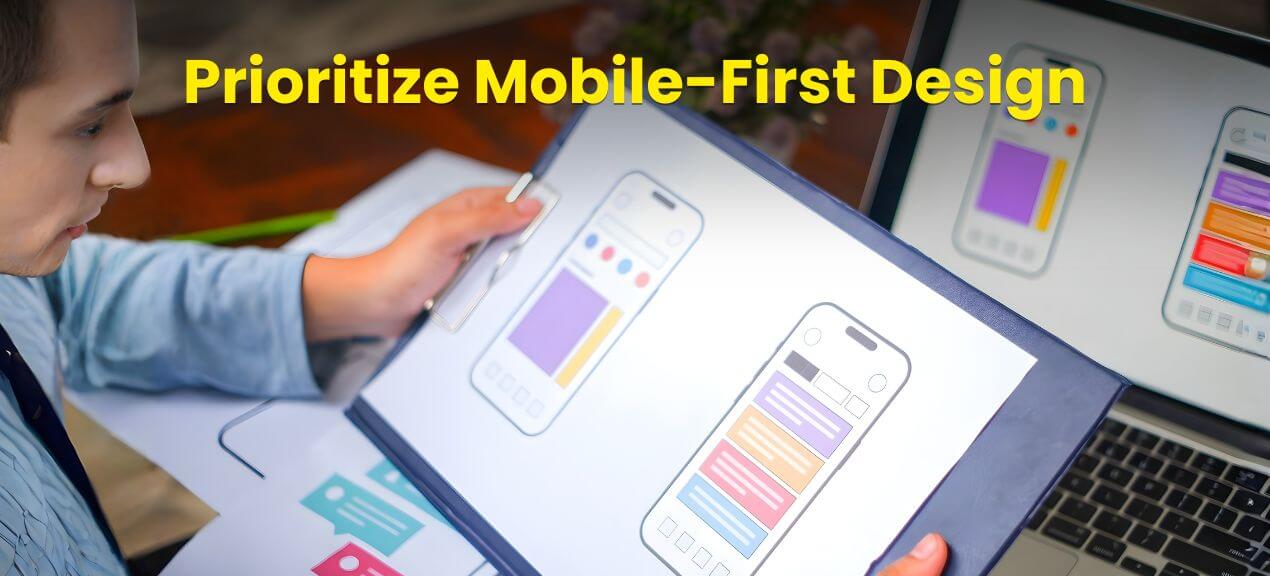
Two sub-concepts, Reconnective Web Design (RWD) and Progressive Advancements and Graceful Degradation, are associated with mobile-first design, which helps to ensure that platforms achieve a “mobile first” approach when creating online and digital platforms.

For developers and web managers, the combination of these concepts as well as those of methodologies is necessary to achieve mobile-first design.

Build Trust Through Design

Because of this, the layout and layout of the page change proportionally with other devices so that when viewed on screen the contents are clearly visible to the eyes.

Users are less compelled to pan, pinch and zoom while browsing the web when RWD is used in your web page design. Why?

Progressive Advancement & Graceful Degradation

Typically, these notions are prioritized over responsive Website UX design incorporation. Developers produce tailored editions of products for various platforms, such as tablets, web browsers and smartphones; mobile devices; and smartwatches, when designing a web design or application interface display for improve user experience that accommodates different screen sizes.

A version of the browser is designed for a user with fewer features and functions, which involves gradual development.

It is generally meant to be the mobile version of the lower-level browser. When finished, developers tend to create the advanced version for tablets or PC, adding more complex effects, animations and interactions to enhance improve user experience.

In contrast, Graceful Degradation initiates its product design process from a more sophisticated perspective, such as desktops, and produces essentially fully rounded versions right from the start.

The developers keep creating deteriorated versions of them and deploying the same functionality on different devices like smartphones, tablets, and other platforms.

Developers and web managers can use these concepts to create a precise representation of their web designs or application, while also guaranteeing that features on different devices are present to deliver optimum customer experience.

Create a Strong Visual Hierarchy

The mind’s ability to comprehend concepts is enhanced by eight principles of visual hierarchy, which are utilized by designers for UX optimization.

  1. The arrangement of a visual element in symphony is known as alignment.
  2. The contrast is present when components that are quite dissimilar are in close proximity. Designers frequently use warm and cool colors or complementary textures to enhance visual appeal and improve contrast ratios for accessibility.
  3. The distance between objects near and far is what qualifies as proximity. One instance where this concept works is the act of grouping or “chunking” objects together.
  4. An object or design element’s size is its measurement. Accessibility can be influenced by the size of user interface components, as Cardona notes. Without giving low-vision users the ability to choose their own size, it becomes difficult to read and comprehend the content.
  5. The texture of a surface or user interface is what gives it the feel and allows design meaning, and can help convey the intended use. Skeuomorphism occurs when UI designers use texture to imitate tactile, real-life material for improve user experience. This can be considered outdated and literal without careful consideration, as Cardona notes.
  6. Printed pages and static products do not show time on screens, unlike screens. A new world of temporal design is opened up by the ability of screens to change, react and change.

 Use High-Quality Images

The presence of images can lead to pages that load slowly. Before uploading to your website, make sure to optimize the images.

Images can reveal more about your brand  for Website UX design than just how fast they load. Do you employ ghost stock photos like other businesses? Request. Are photographs of actual individuals utilized?

For example, we recommend that Legiit users add their original pictures to their service thumbnails. Generally speaking, we observe that those who utilize such images tend to make more sales than those with less unique imagery.

Make CTAs Clear

Your “call to action” is just as important as your content and design for UX optimization. It’s the final stage of your funnel that can either enhance or harm your overall UX performance.

  • Unfortunately, there’s no one-fit-all CTA. You must adjust it to find what suits you.
  • Enhance the texture of your CTA buttons by adding texture.
  • Add emotional cues – for the moment, abandon your basic rake.
  • Employ sensory terms to depict your products.
  • To sum up, exhibit your CTA buttons and moderate their placement on the pages.

Test & Improve Continuously

It has been reported that 42% of users use images for Website UX design on product pages to determine the size of a product, but without an “In Scale” image, it can be challenging.

A clear lack of usability can have a significant impact on enhancing improve user experience and website ranking.

7 Smart UI Improvements to Keep Visitors Happy & Engaged

There is only one reliable method to determine whether your user interface designs are “good” or not, regardless of design trends: do they function for actual users—your users?
Even if a design appears perfect on paper, users’ experience is essentially ruined if they are unable to understand something as basic as where to click next. They might turn to a competitor if they have trouble using your product or making purchases from your website. In a similar vein, a design may appear simple, antiquated, or even outright strange

Simplify Navigation

The success of your website depends on two crucial functions that website navigation fulfils.  To begin with, it makes it simple for users to navigate between website UI improvements from anywhere on the website. Second, it quickly explains the main idea of your website to visitors who do not enter through the homepage.
On the other hand, poor navigation can cause a lot of problems. I’m referring to higher bounce rates, shorter site dwell times, lower conversion rates, and eventually lower profits. In order to maintain your B2B prospects’ satisfaction and engagement, it is imperative that you improve your navigation.

Website navigation’s function in the user experience

In addition to website UI improvements find the data they need quickly, a well-designed navigation bar on a website is essential for fostering an enjoyable user experience that increases revenue, retention, conversions, and brand loyalty. According to a Baymard Institute report, online retailers have an average abandoned cart rate of 58.6%, with a poor user experience accounting for 30% of those abandonments.
It’s critical to design site navigation that complements the website’s distinctive and captivating content while remaining simple and predictable to prevent abandonment.
That website designers need to take into account:

  • The list of pages users can access;
  • The users’ present location on the website
  • The process by which users obtain the information they require

    While bad website navigation for website UI improvements can result in a number of problems, such as a higher bounce rate or fewer conversions, an efficient web navigation design can reduce the learning curve and boost conversions and revenue. Your search engine optimisation (SEO) efforts would be ruined by that.

Improve Page Load Speed

Did you know that 10–60% of viewers will abandon a site if they are unable to find what they are looking for in 15 seconds? Consequently, it is essential to create easy to navigate intuitive websites that offer an excellent user experience. Don’t let your website cause users to quickly abandon their search. Instead, make sure that the navigation on your website is easy to use, fluid, and swiftly gets users to the information they need.

Key Factors Affecting Speed

Consider how each element affects the speed at which your website loads as you go through this section and decide which fixes to start with.

Selecting an e-commerce platform
Your site’s ability to manage traffic, load content, and react to user interactions is determined by the CMS. This is a result of the investments made by contemporary CMS to offer users native optimisations that take effect automatically.
You can ensure that you maintain user engagement, lower bounce rates, and raise your search engine rankings if you make the right decision based on your type of business.

Make Your Design Mobile-Friendly

According to 57% of users, they won’t suggest a company whose mobile presence is badly designed.  Designing the user experience prior to, during, and following the app’s use is the aim of mobile UX designers.
Usefulness, usability, desirability, accessibility, and credibility are all important aspects of the design. Useful: The system must satisfy the needs and desires of the users.

Relevant: It should be as simple and self-explanatory as possible.

Ideal: The system’s design should inspire gratitude and good reactions. Your system must be appealing to users.

Searchable: The system should be simple to use and self-descriptive. Additionally, users need to locate crucial information fast.

Accessible: Users with disabilities, such as those with extremely low vision, must be able to utilize your system and experience it in the same way as users without disabilities.

Credible: Customers need to have faith in you and your offering.

Use Readable Fonts & Colors
To put these ideas into practice, designers ought to:
To learn about the needs of their target audience for website UI improvements, conduct user research.
Make scenarios and user personas to help them with their design choices.
Priorities the most crucial interactions and content for the mobile experience by adopting a mobile-first strategy.

Use Readable Fonts & Colors

The study of how colors impact human emotions and behavior is known as color psychology. Colors can be used to elicit particular feelings or emotions and have a strong effect on our subconscious minds.
Color psychology can be applied to UI/UX design to produce a more compelling and successful user experience. Designers can select colors that will help users achieve their objectives and elicit the desired emotions in them by knowing the psychology of color.
How to Find and Repair Broken Links.  I take it that you came here because you discovered some weak connections on your website?

Fix Broken Links & Errors

Free and efficient specialised tools include Ahrefs’ Broken Link Checker and the W3C Link Checker. Just enter the URL of your website and give the tool a few minutes to check for links. After that, a comprehensive list of links that require updating ought to appear. The bad news is that you will now have to manually update each of these one at a time.
This can involve deleting the link entirely, changing to the updated URL for a specific page, or correcting typos.  Install a WordPress plugin that checks for broken links.

Keep Forms Short & Simple

Go to your WordPress admin area and select Plugins > Install New Plugin.
Find “Broken Link Checker” online. It’s the one that appears as follows:
Next, navigate to the WordPress sidebar and locate the recently added “Link Checker” option.  It’s also more thorough. You will have to register for a free account, which is a drawback.
Local (old): This initiates a local search. This depends on the servers of your host, but it functions well for the majority of SMB websites.
After scanning your website, the plugin will show you how many broken links you have.

Use Clear Call-to-Actions (CTAs)

Don’t disregard design guidelines. However, since usability depends on familiar patterns, innovation should avoid dominating. Make use of existing design principles to make navigation appear clear.
Be careful not to confuse users when introducing new solutions. People become more at ease with a brand the more they know it, and satisfied customers are more likely to stick with it.

Design Your Interfaces to Be Easy to Learn Keep it simple!

Final Words

Did you know that if they can’t find what they’re looking for within 15 seconds, 10–60% of website visitors for website UI improvements will leave? Therefore, developing user-friendly, intuitive websites that provide a great user experience is crucial. Don’t allow users to quickly give up on their search because of your website. Rather, ensure that your website’s navigation is fluid, user-friendly, and quickly directs visitors to the information they require.